

Order an Italian meal expecting pasta followed by a main course, and you may already be applying a dining structure that does not quite fit.
In traditional Italian dining, pasta can be the primo, meat or fish may arrive separately as the secondo, and vegetables can be served as their own contorno. Even then, what appears on the table can change with the region, occasion, and people sharing the meal.
That is what makes Italian food culture more interesting than a list of famous dishes. Regional cuisine, the knowledge passed down from generation to generation, the social experience of sharing a meal: all of these are the basis of Italy’s food traditions.
So, what does traditional Italian dining actually look like? Understanding the courses, regional differences, and shared-table traditions gives us a much better picture of Italian cuisine than pasta and pizza alone.
What Is Italian Food Culture?
Italian food culture is about the food culture in Italy, which comprises the regional culinary practices, ingredients, recipes, and social customs related to preparing and eating food in Italy. It is closely tied to regional identity, family knowledge, and the experience of eating with other people.
There is no single menu that represents the whole country. Foods associated with Calabria can be quite different from those found in Sicily, Tuscany, Piedmont or other parts of Italy. Recipes can vary between regions and even between families.
This regional character is central to Italian culinary culture. Understanding Italian food means looking at where dishes come from, how they are prepared, and the traditions surrounding the meal rather than trying to define the cuisine through a handful of internationally famous foods.
Why Is Regional Food So Important in Italy?
Regional diversity is one of the defining features of Italian food traditions.
Italy’s geography stretches from the Alps through a long Mediterranean peninsula and its islands. Climate, agriculture, locally available ingredients, and generations of cooking traditions have all contributed to regional differences.
Those differences appear in pasta shapes, sauces, breads, cheeses, meat and seafood dishes, desserts and cooking methods. A dish associated with one part of Italy may be prepared differently elsewhere or may have little connection with another region at all.
Calabria, for example, has its own culinary traditions and ingredients. This regional connection is also relevant to Compà in Mount Hawthorn, whose restaurant concept draws inspiration from a trattoria in Calabria.
Rather than asking what a single “traditional Italian dish” looks like, it is often more useful to ask which part of Italy the dish or cooking style comes from.
How Does a Traditional Italian Meal Work?
A longer traditional Italian meal can move through several courses. However, this does not mean every Italian lunch or dinner includes all of them.
Here is a simple way to understand the traditional sequence:
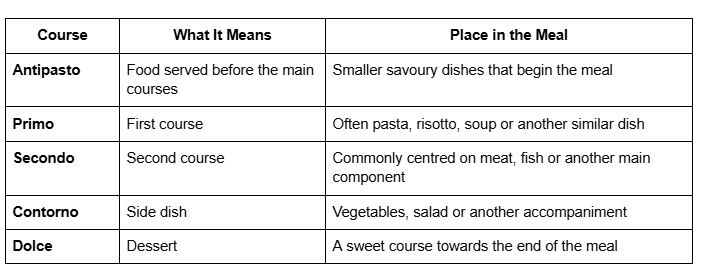
An everyday lunch can be considerably simpler. Longer meals are more likely to provide room for several courses, particularly when people are gathering for a celebration or special occasion.
The course structure is therefore useful for understanding traditional Italian dining, but it should not be treated as a compulsory set of rules.
Why Does Sharing Food Matter in Italian Dining Culture?
Food in Italy has a strong social aspect. In fact, when UNESCO described Italian cooking, it specifically pointed to sharing moments around the table, exchanging recipes and stories, and passing culinary knowledge between generations as parts of the cultural practice.
That makes the meal about more than simply serving individual dishes. Cooking and eating can create time for families and communities to gather, talk, and maintain traditions.
This idea of conviviality remains one of the most recognisable aspects of Italian dining culture, although the way people experience it naturally differs between households, regions and occasions.
It also translates well into contemporary restaurant dining. At Compà Mt Hawthorn, for example, the current menu includes warm and cold Italian tapas alongside pasta, pinsa, meat and seafood dishes, with set menus that include selections designed to be shared.
The setting is modern and distinctly Perth, but sharing several dishes around one table reflects an important social element associated with Italian dining.
Does Traditional Italian Food Have to Be Complicated?
Not necessarily. Some Italian dishes use relatively few ingredients, but fewer ingredients should not be confused with a lack of technique or variety.
UNESCO’s description of Italian cooking refers to the use of raw materials, artisanal food preparation techniques, and respect for ingredients. Knowledge of how ingredients are handled and combined can therefore be just as important as the number used in a recipe.
This helps explain why seemingly straightforward foods can differ considerably from place to place.
Pasta is a good example. Shapes, preparations and accompanying ingredients vary across Italy. Bread, cheeses, cured foods, seafood and desserts show similar regional differences.
The result is a cuisine where individual ingredients and established combinations often have room to stand out rather than being hidden beneath unnecessary complexity.
Pasta Is Important, but It Is Only Part of Italian Cuisine
Pasta has become one of the world’s most recognisable Italian foods, but Italian food culture extends much further.
Depending on the region and occasion, meals may include rice, polenta, soups, vegetables, seafood, meat, bread, cheeses and many other foods. Even within pasta there is considerable variety in shapes, ingredients, sauces and preparation.
Looking beyond one or two famous dishes gives diners a better understanding of how varied Italian cuisine can be.
If you are exploring Italian dining locally, our Italian dining guide for Perth also looks at menus, dining styles and some of the things worth considering when choosing where to eat.
Where Does Pinsa Fit Into Italian Dining?
Pinsa is a useful example of how contemporary Italian dining can include foods that diners may initially compare with more familiar dishes.
Compà describes pinsa as a Roman-style alternative to pizza. While the two may look similar at first glance, pinsa has its own preparation and presentation.
On Compà’s current menu, pinsa sits alongside homemade pasta, Italian tapas, meat, seafood and other dishes. It is also available in different sizes intended for sharing, making it particularly suited to the restaurant’s group-dining format.
Its place on a contemporary Italian menu is also a reminder that Italian dining traditions are not frozen in time. Food culture continues to develop while maintaining connections with regional ingredients, techniques, and the social experience of eating together.
Are Traditional Italian Meals Always Long?
No. Italian dining should not be reduced to the stereotype that every meal lasts several hours.
The length and structure of a meal depend on the occasion. An ordinary meal can be simple, while a family gathering, celebration or leisurely lunch may involve more courses and more time around the table.
The social element is more useful for understanding Italian dining traditions than measuring how long people eat.
A shared meal creates opportunities for conversation and for several foods to be enjoyed over the course of the gathering. The exact form that takes can change considerably between everyday life and special occasions.
How Are Italian Food Traditions Passed Down?
Recipes are only one part of the process.
Cooking techniques, ingredient knowledge, family variations and the habits surrounding meals can all be learned by watching, helping and cooking with other people. UNESCO specifically identifies the transmission of flavours, skills and memories across generations as part of the cultural significance of Italian cooking.
That means a recipe can carry more than instructions. It may also contain regional knowledge, family preferences and techniques learned from previous generations.
At the same time, traditions continue to change. People move, ingredients become available in new places, and younger generations adapt what they have learned. Italian food culture therefore continues to develop rather than existing as a fixed collection of historical recipes.
What Can Italian Dining Culture Teach Us About the Meal?
Perhaps the most useful lesson from traditional Italian dining is that a meal does not have to revolve around one plate.
The sequence of courses, regional variation, and tradition of sharing food all encourage diners to think about the meal as a whole. One dish can lead into another, several foods can be shared, and the table itself becomes part of the experience.
This does not mean every Italian meal follows the same format. Quite the opposite. Regional and family differences are part of what makes the cuisine interesting.
Understanding that variety makes it easier to appreciate Italian food without reducing it to a handful of familiar dishes or rigid ideas about what is “authentic”.
Explore Italian Dining in Mount Hawthorn
Learning about Italian food culture can change the way you read an Italian menu. Instead of looking only for familiar dishes, you start to notice regional influences, the progression of courses, different preparations and foods intended for sharing.
Compà brings its own interpretation of Italian dining to Mount Hawthorn, with a concept inspired by Calabria and a current menu featuring Italian tapas, homemade pasta, pinsa, meat, seafood and desserts.
You can explore the current menu, restaurant and dining options at Compà Mt Hawthorn.
FAQs
What is Italian food culture?
Italian food culture includes the regional recipes, ingredients, cooking methods, and social traditions associated with the preparation and consumption of food. There is great variation across Italy and therefore no one menu can represent the whole country. Regional identity, family knowledge, shared meals, and traditions passed down through generations are all important aspects of Italian food culture.
What is traditional Italian dining?
Traditional Italian dining can involve several courses, particularly during longer or special meals. These may include antipasto, a primo such as pasta or risotto, a secondo, a contorno and dessert. Everyday meals can be much simpler, however, so this course structure should be understood as a tradition rather than a requirement for every meal.
Why is food important in Italian culture?
Food has both culinary and social importance in Italian culture. Cooking knowledge and recipes can pass between generations, while meals provide opportunities for families and communities to spend time together. UNESCO recognised these cultural practices in 2025 when it inscribed Italian cooking on its Representative List of the Intangible Cultural Heritage of Humanity.
Is Italian food the same throughout Italy?
No. Italian food varies so much from region to region, from local community to local community. Geography, agriculture, available ingredients, and local traditions have all contributed to different recipes, ingredients and methods of preparation. This regional diversity is why it is more accurate to think of Italian cuisine as a collection of related food traditions, rather than one uniform style of cooking.
What is the traditional order of an Italian meal?
A longer Italian meal may start with antipasto before moving to a primo, which can include pasta, risotto or soup. A secondo may follow, often accompanied by a contorno such as vegetables or salad. Dolce can come towards the end. Not every Italian meal includes every course, particularly in everyday dining.
What makes Italian dining a social experience?
When people eat together, they can talk, share dishes, and keep food traditions alive. For Italian food culture, UNESCO emphasizes the value of shared moments at the table, exchanging recipes, stories, and knowledge of cooking. How this happens differs from family to family and occasion to occasion, but the communal aspect is a key part of the tradition.